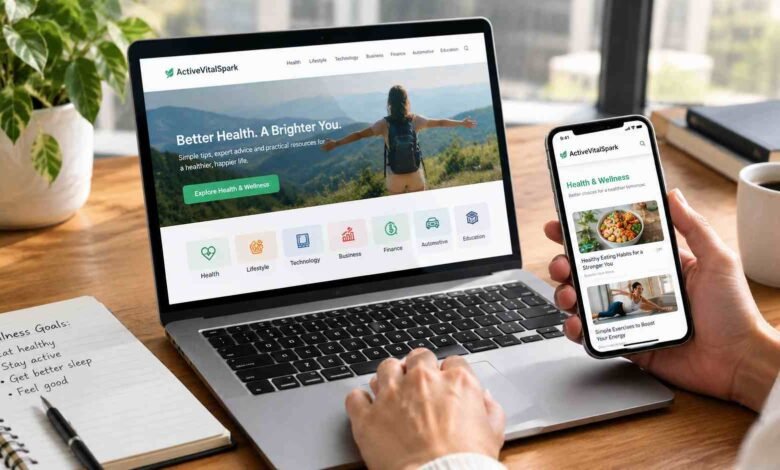
Searching for activevitalspark com usually means you want a simple answer: What is this website, what does it cover, and can you rely on what you read there?
ActiveVitalSpark.com is presented online as a general-interest informational site with a strong health and wellness identity, but it also covers topics outside health. Current search results describe categories including Health, Lifestyle, Technology, Business, Finance, Automotive, and Education.
In brief: ActiveVitalSpark.com appears to be a multi-topic content website rather than a dedicated medical portal. It can be used for general reading and topic discovery, but health claims should be checked against trusted medical sources, especially when they could affect treatment, medication, supplements, or a diagnosed condition. NIH guidance recommends checking who wrote health content, whether it has expert review and citations, how current it is, and who operates the site.
Key Takeaways
- ActiveVitalSpark.com is not limited to health content. Search results describe several editorial categories.
- The exact query “activevitalspark com” is mainly navigational, so users are usually looking for information about the domain itself.
- The site has been described by recent third-party pages as a WordPress-based informational blog.
- Direct access to the live site was restricted during this review, so claims that require full on-site verification should be treated carefully.
- Health information should be judged by the quality of the author, sources, review process, and update date, not simply by how professional a page looks.
- The FDA advises consumers to discuss supplements with a health professional and not assume that “natural” automatically means safe.
- For high-stakes health questions, use official or medically trusted sources rather than relying on one general-interest website.
What Is ActiveVitalSpark Com?
ActiveVitalSpark.com is described in current search results as an informational website covering health, wellness, lifestyle, and several unrelated practical subjects. One recent review lists seven broad categories: Automotive, Business, Education, Finance, Health, Lifestyle, and Technology.
That matters because the domain should not automatically be treated as a specialist health publisher.
A website can have a health category without functioning like a medical reference service. A general-interest blog may explain wellness topics for everyday readers, while a medical organization may publish treatment guidance supported by clinical expertise, references, and formal review systems.
For that reason, the most useful way to understand ActiveVitalSpark is to separate site identity from medical authority.
7 Helpful Facts About ActiveVitalSpark Com
1. The domain covers more than health
The strongest recurring signal in current search results is that ActiveVitalSpark.com is a multi-topic publication.
Health is one category, but other listed sections include Finance, Technology, Business, Education, Lifestyle, and Automotive.
This makes the website broader than a typical health-only publication.
For a reader, that means the site may be useful for general topic discovery, but you should not assume that every article is written to the same professional standard as content from a medical institution.
2. Search intent around the domain is mostly informational and navigational
When someone types activevitalspark com into Google, the query itself gives away a lot about the goal.
They may want to:
- Find the website
- Understand what it is
- Learn what topics it publishes
- Decide whether to read its content
- Check whether the site appears trustworthy
That explains why the current SERP contains several domain-explainer articles instead of pages about a specific disease, exercise routine, or supplement.
For content creators, this is important. Trying to force the keyword into a medical article would create an intent mismatch.
3. Third-party sources describe it as a WordPress site
Recent third-party reviews identify ActiveVitalSpark.com as a WordPress-based publication, with one source specifically describing the “News Vault” theme by Ascendoor.
A WordPress installation does not tell you whether content is accurate or inaccurate. It is simply a publishing technology.
The more important questions are editorial ones:
Who writes the article?
What evidence is cited?
Has the information been reviewed?
When was it updated?
Does the page clearly separate educational information from medical advice?
Those questions have more value than judging a site by its software platform.
4. Health content deserves a higher verification standard
This is the most important point for anyone researching ActiveVitalSpark.com.
The National Institute on Aging says readers should check who wrote health information, whether the author or reviewer has relevant expertise, whether the site provides citations, when the material was written or updated, and who operates or sponsors the website.
The NIH also warns readers to be cautious of health sites that promote quick fixes or “miracle” solutions.
So, when you read a health article on ActiveVitalSpark.com, do not judge it only by its headline or presentation. Look for evidence.
A useful rule is:
Good presentation is not the same thing as medical authority.
5. A general health article can be useful without replacing medical care
There is nothing wrong with using a general website to learn basic concepts.
For example, a reader might use an article to understand:
- What a nutrition term means
- Why physical activity is associated with health benefits
- What questions to ask a doctor
- What a wellness trend is claiming
- Which topics deserve more research
That can be a useful first step.
The problem begins when a reader treats a general article as personalized medical advice.
NIH guidance specifically says online information should not replace professional evaluation for an individual’s health situation.
6. Supplement claims need extra caution
If an ActiveVitalSpark.com article discusses vitamins, herbs, performance products, or other dietary supplements, readers should verify the claims through stronger health sources.
The FDA explains that dietary supplements are not approved by the agency for safety and effectiveness before they reach the market in the same way drugs are. The agency also advises consumers to talk with a doctor, pharmacist, or other qualified health professional before deciding to use a supplement.
The FDA also notes that supplements can interact with medications, affect lab tests, or cause other problems in some circumstances.
That is why a health article should not be treated as proof that a supplement is effective or safe for a particular person.
7. The smartest approach is to use the site as one source, not the only source
This is where a practical reader strategy helps.
Suppose an article on ActiveVitalSpark.com discusses a wellness habit. You can read it to understand the topic. Then check a government health resource, major medical organization, or academic medical source for claims that matter.
For general health information, NIH guidance recommends starting with trusted sources such as NIH and CDC websites.
This two-step approach is much stronger than asking whether a website is simply “good” or “bad.”
How to Evaluate ActiveVitalSpark Com Health Content
Use this five-part check before acting on a health claim.
| What to check | Why it matters |
|---|---|
| Author | Shows who is responsible for the information |
| Medical or expert review | Helps establish whether a qualified person reviewed the material |
| Sources and citations | Lets you verify important claims |
| Publish/update date | Health guidance can change |
| Purpose and sponsorship | Helps you spot possible promotional bias |
These points closely match NIH guidance for evaluating health information online.
A simple example
Imagine you find an article claiming that a certain supplement can improve energy.
Before acting on it, ask:
- Who wrote the article?
- Is the claim supported by research?
- Are references provided?
- Is the article recent?
- Are risks or side effects discussed?
- Could the supplement interact with medication?
- Can the claim be confirmed through the FDA, NIH, or another trusted source?
If the article does not answer those questions, that does not automatically mean it is false. It means you should verify it before acting on it.
ActiveVitalSpark Com vs. Official Health Sources
| Need | ActiveVitalSpark.com | NIH / CDC / FDA |
|---|---|---|
| General topic discovery | Useful | Useful |
| Easy-to-read background information | Potentially useful | Yes |
| Government health guidance | No | Yes |
| Supplement safety information | May discuss it | FDA is better suited |
| Personalized medical advice | Not a substitute | Still requires a clinician |
| Verifying high-stakes claims | Secondary source | Stronger starting point |
For example, CDC currently provides evidence-based information on the health benefits of physical activity, including immediate and long-term benefits.
That makes CDC a stronger source for confirming a specific physical-activity claim than a general-interest blog.
NIH guide to finding reliable health information
FDA consumer information on dietary supplements
What the Current SERP Tells Us About ActiveVitalSpark Com
The current search results are interesting because several sites published domain explainers within a relatively short period in 2026. Many of them use similar structures: what the site is, what it covers, who it is for, whether it is safe, and FAQs.
That creates an opening for a better article.
Instead of repeating the same “this is a wellness platform” language, a stronger page should answer the user’s real questions:
What is it?
A general-interest informational website with a health category and several other sections.
Is it a medical authority?
The available evidence does not justify treating the domain as a replacement for professional medical care.
Can its health information be useful?
Potentially, as general educational reading, provided important claims are independently checked.
What should you do with high-risk advice?
Verify it through trusted medical or government sources and speak with a qualified professional when needed.
One Common Mistake to Avoid
A common mistake is treating a health-focused website as a health authority simply because the site looks polished.
Design, categories, headlines, and confident wording do not establish clinical credibility.
For health content, the more useful signals are author identity, expert review, citations, update dates, transparency about the organization, and the ability to verify important statements independently. NIH guidance specifically recommends looking for these signals.
Who Might Find ActiveVitalSpark Com Useful?
The site may suit readers who want accessible explanations and general topic discovery.
It can be useful for:
- Beginners researching wellness topics
- Readers browsing several everyday subjects in one place
- People who want a starting point before doing deeper research
- Users looking for plain-language explanations
It is less suitable as a sole source when you need:
- Personalized diagnosis
- Treatment decisions
- Medication guidance
- Detailed supplement safety decisions
- Emergency medical information
For those situations, move to a qualified medical professional or an authoritative health source.
3 Practical Steps Before Trusting a Health Claim
Step 1: Trace the claim
Look for the study, organization, expert, or official source behind the statement.
Step 2: Check a second source
For health claims, compare the information with sources such as NIH, CDC, FDA, major hospitals, or recognized medical organizations. NIH recommends checking trusted sources rather than relying on one website.
Step 3: Consider your own situation
Even accurate general information may not apply to you.
A supplement that is reasonable for one person may be inappropriate for another because of medications, allergies, pregnancy, an existing condition, or other factors. The FDA specifically advises consumers to discuss supplement choices with health professionals.
Is ActiveVitalSpark Com Worth Visiting?
For general reading, it can be reasonable to explore.
The available search evidence shows ActiveVitalSpark.com as a broad informational site with a Health category alongside Finance, Technology, Business, Education, Lifestyle, and Automotive content.
The important distinction is how you use it.
Treat general wellness articles as educational material, not personalized healthcare. Verify important claims, pay attention to authorship and citations, and use government or medical sources when the stakes are higher.
That approach is safer and more useful than blindly trusting or dismissing any website.
Conclusion
ActiveVitalSpark com is best understood as a broad informational website rather than a dedicated medical authority. Current search results associate the domain with Health and Wellness content, but they also show a much wider mix of categories.
The best way to judge its health content is not by branding alone. Check the author, sources, review process, update date, and purpose of the page. NIH recommends these same types of checks when evaluating online health information.
3 practical next steps
- Read the article for background and context.
- Verify important health claims through NIH, CDC, FDA, or another trusted medical source.
- Talk with a qualified healthcare professional before making significant changes to treatment, medication, or supplement use.
FAQs About ActiveVitalSpark Com
What is ActiveVitalSpark com?
ActiveVitalSpark.com is described in current search results as a general-interest informational website covering health, lifestyle, technology, finance, business, education, and automotive topics.
Is ActiveVitalSpark com a health website?
Health is one of the site’s listed categories, but the domain is broader than a health-only publication.
Can I trust health information on ActiveVitalSpark com?
Use it as general educational material and verify important health claims through stronger sources. NIH recommends checking authorship, expert review, citations, update dates, and site ownership when evaluating health information online.
Does ActiveVitalSpark com replace a doctor?
No. General online information should not replace professional evaluation or personalized medical care.
Should I trust supplement recommendations from any health blog?
No. The FDA advises consumers to understand supplement risks and discuss supplement use with a healthcare professional, especially because supplements can interact with medications and are not approved for safety and effectiveness before marketing in the same way drugs are.
What should I check before believing a health claim online?
Check who wrote it, whether an expert reviewed it, what sources support it, when it was updated, and who operates or sponsors the website.
Is ActiveVitalSpark com useful for beginners?
It may be useful for readers who want accessible, general information and a starting point for further research. For high-stakes health decisions, use authoritative medical sources and professional guidance.
Where should I verify important health information?
NIH and CDC are strong starting points for general health information, while the FDA is especially useful for consumer information about dietary supplements and related safety issues.

