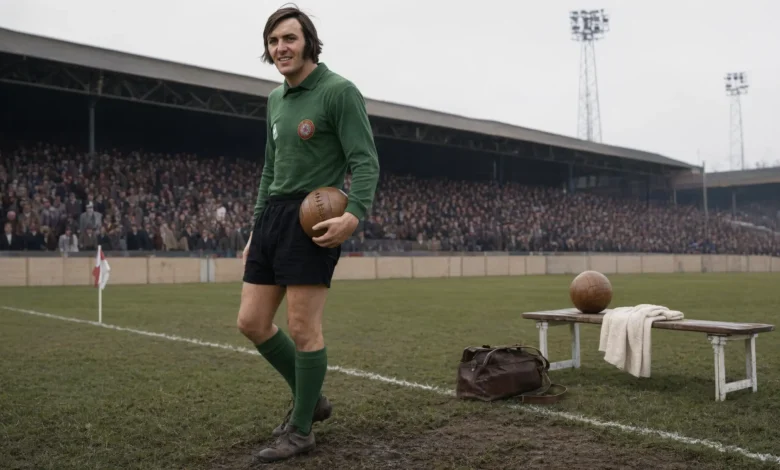
Jimmy Rimmer, the goalkeeper who won the European Cup with Manchester United in 1968 and with Aston Villa in 1982, has died at the age of 78. He spent precisely nine minutes of those two finals on the pitch, an unused substitute at Wembley the first time and a ninth-minute injury in Rotterdam the second, which makes him still the second player in history to win the trophy with two clubs and the only one who was off the field at the final whistle of both.
His former clubs confirmed the news on Friday 14 August 2026. According to Jim White’s obituary, his death followed a fall at his home in Swansea, the city where he settled after a coaching career that carried him from the Vetch Field to China and Canada.
The short version, for anyone arriving from a headline: Rimmer was one of the finest goalkeepers of his generation in England, a league title winner, a two-time European Cup winner, and a man whose two most famous moments happened while he was sitting down or walking off. The rest of a 470-game career deserves more than that paradox.
Nine minutes in Rotterdam
By May 1982, Rimmer was the fixed point of the best defence in Europe. He had kept a clean sheet against Anderlecht in the semi-final to send Villa through, and he was one of only five players to start all nine of the club’s European Cup matches that season, according to Aston Villa’s own tribute. Then, nine minutes into the final against Bayern Munich, his neck went.
Nigel Spink, 23 years old and one first-team appearance into his career, came on. The body keeps its own calendar and interrupts the biggest nights, as Rod Stewart’s farewell tour has been learning this summer. Spink produced the game of his life. Rimmer, treated in the dressing room by club doctor David Targett, was in tears, though he made it back to the dugout in time to watch Peter Withe’s shin turn Tony Morley’s cross into the winning goal.
Jim White later described the photograph that followed: Villa fans in delirium in the background, team-mates grinning, and Rimmer in the foreground with his hands on his hips and a look of bemused despondency on his face. He had believed, with every good reason, that this was to be his night.
Eleven years at Old Trafford, mostly watching
Born in Southport in February 1948, Rimmer joined Manchester United as a schoolboy in 1963 and turned professional two years later. The problem was Alex Stepney. Stepney did not get injured, did not get dropped, and did not go away, and Rimmer managed 46 senior appearances in eleven years, most of them spent watching from the bench. That bench included the 1968 European Cup final, when United beat Benfica 4-1 and Rimmer collected his first medal without pulling on a glove.
A loan spell at Swansea City in the autumn of 1973, seventeen games of actual first-team football, showed him what he had been missing. Arsenal paid £40,000 for him in the spring of 1974.
Arsenal’s No.1 and the one-cap England keeper
At Highbury he finally became a first-choice goalkeeper, succeeding the retiring Bob Wilson and missing just three matches over three seasons. He won Arsenal’s Player of the Year award in 1975 and, a year later, his single England cap in a friendly against Italy, a game he was substituted at half-time of, which tells you most of what you need to know about keeping goal in the era of Ray Clemence and Peter Shilton.
Then Terry Neill arrived as manager and brought Pat Jennings with him from Tottenham. Rimmer was 29, at his peak, and asked for a way out. It is the calculation every understudy eventually faces, the mirror image of Trent Alexander-Arnold’s Spanish gamble: trade the comfort of a big address for the chance to actually play.
The backbone of Villa’s golden age
Ron Saunders paid a bargain £65,000 for him in August 1977, by Aston Villa’s own account, and got the most reliable goalkeeper in the league. Rimmer made 229 league appearances and 287 in all during six seasons as first choice. He was one of seven ever-presents in the title-winning campaign of 1980-81, adding the Charity Shield that autumn and the European Super Cup in 1982. The Birmingham Mail once described him as perhaps the greatest goalkeeper in Aston Villa’s history.
The 1982 medal also made him, per Wikipedia’s tally, only the second player after Saul Malatrasi to win the European Cup with two different clubs. He recovered from his neck injury and kept his place for the first half of the 1982-83 season, but Spink was waiting, and Rimmer played his final Villa game in a Second City derby just after Christmas.
The second act, three continents
He returned to Swansea in 1983, this time permanently, and finished his playing days with spells at Hamrun Spartans in Malta and at Luton Town before retiring in 1986. What followed was the quieter, longer career that football mislays so quickly, the backroom life this site examined in the short, full football life of Alex Hughes. Rimmer became Swansea’s goalkeeping coach, then twice stepped up as caretaker manager during the grim 1995-96 season, after the departures of Bobby Smith and Kevin Cullis and before Jan Mølby arrived.
After that came China, where he coached the national team’s goalkeepers and worked at Dalian Shide, and Canada, before retirement to Gorseinon. “Since I finished in Canada and China, coaching the national team, I do little bits on match-days at Arsenal, Villa, Manchester United and Swansea,” he said in an interview reproduced by his speaking agency. A humble, quiet man, deeply respected by all who knew him, is how Swansea City put it this week.
Career in numbers
|
Club
|
Years
|
League appearances
|
|---|---|---|
|
Manchester United
|
1965-1974
|
34
|
|
Swansea City (loan)
|
1973
|
17
|
|
Arsenal
|
1974-1977
|
124
|
|
Aston Villa
|
1977-1983
|
229
|
|
Swansea City
|
1983-1986
|
66
|
Honours: European Cup 1968 (Manchester United) and 1982 (Aston Villa), First Division title 1981, Charity Shield 1981, European Super Cup 1982, and Arsenal’s Player of the Season in 1975.
Tributes
Aston Villa’s statement called him one of the finest goalkeepers of his generation and arguably one of the unluckiest when it came to big occasions, noting that despite two European Cup medals he was not on the pitch at the end of either final. Manchester United said they were deeply saddened by the loss of their former goalkeeper.
Alex Stepney, the man whose presence defined half of Rimmer’s career, wrote: “Such sad news to hear Jimmy Rimmer has passed away, rest in peace and lots of love to Jimmy’s family x.” England’s official X account remembered his single cap. Swansea City will remember him, alongside others of the Swansea family lost this year, before the Sheffield United match on 22 August.
What people are asking about Jimmy Rimmer
Did Jimmy Rimmer win the European Cup with two different clubs?
Yes. He was an unused substitute for Manchester United’s 1968 win and started, before his ninth-minute injury, in Aston Villa’s 1982 win, making him the second player after Saul Malatrasi to win the trophy with two clubs.
Who replaced Jimmy Rimmer in the 1982 European Cup final?
Nigel Spink, then 23 and with one previous first-team appearance, who kept a clean sheet against Bayern Munich.
How many times did Jimmy Rimmer play for England?
Once, in a 1976 friendly against Italy, from which he was substituted at half-time. The Clemence-Shilton duopoly blocked him throughout his peak.
What did Jimmy Rimmer do after retiring?
He became Swansea City’s goalkeeping coach, served twice as caretaker manager in 1995-96, coached in China with the national team and Dalian Shide, worked in Canada, and retired to Gorseinon near Swansea.
How did Jimmy Rimmer die?
He died on 14 August 2026, aged 78. Press accounts, including Jim White’s obituary, say his death followed a fall at his home in Swansea. His family have not publicly given further detail as of Saturday 15 August 2026.
There is a photograph from the morning after Rotterdam, taken by David Bagnall, in which the two Villa goalkeepers hold the European Cup between them at an airport arrivals hall, one handle each. It is the most honest portrait of Rimmer’s career anywhere in the archive. The trophy was his. It was never only his. He held on anyway.
SOURCES
- BBC Sport, “European Cup winner Rimmer dies aged 78” — confirmed the death, age, the 1968 and 1982 finals facts, the single England cap and the Stepney tribute. — Published: 14 August 2026 — Accessed: 15 August 2026
- Aston Villa FC, “Tribute to Jimmy Rimmer” — the club’s full statement: the £65,000 fee, ever-present statistics, the dressing-room tears, treatment by Dr David Targett and his return to the dugout for Withe’s goal. — Published: 14 August 2026 — Accessed: 15 August 2026
- Yahoo Sports / Jim White, “Jimmy Rimmer, goalkeeper cruelly denied moment in the sun, dies at 78” — the fall at his Swansea home, the half-time substitution in his one England cap, the Anderlecht semi-final clean sheet and the description of the post-final photograph. — Published: 14 August 2026 — Accessed: 15 August 2026
- Wikipedia, “Jimmy Rimmer” — the career appearance table, the honours list and the Saul Malatrasi two-club record; it also preserves the Birmingham Mail’s description of him as perhaps the greatest goalkeeper in Villa’s history. — Published: continuously updated, death added 14 August 2026 — Accessed: 15 August 2026
- Arsenal FC, “Jimmy Rimmer | 1948 – 2026” — the £40,000 fee, 146 appearances, the 1975 Player of the Year award and the succession of Bob Wilson. — Published: 14 August 2026 — Accessed: 15 August 2026
- Birmingham Mail, “Aston Villa legend Jimmy Rimmer dies as tributes pour in for European Cup winner” — the Manchester United and England X tributes and the full Villa statement. — Published: 14 August 2026 — Accessed: 15 August 2026
- Swansea City AFC, “Swansea City mourns the passing of Jimmy Rimmer” — the two caretaker managerial spells, coaching in China and Canada, retirement to Gorseinon and the planned remembrance before the Sheffield United match on 22 August. — Published: 14 August 2026 — Accessed: 15 August 2026
- Superstar Speakers, tribute post preserving Rimmer’s own interview quote — the first-person quote about his match-day roles at Arsenal, Villa, United and Swansea after coaching in Canada and China. — Published: 14 August 2026 — Accessed: 15 August 2026
- Alamy, David Bagnall photograph, image ref BPRM73 — provenance of the 1982 airport photograph of Rimmer and Spink with the European Cup used as the hero image. — Published: archive listing — Accessed: 15 August 2026