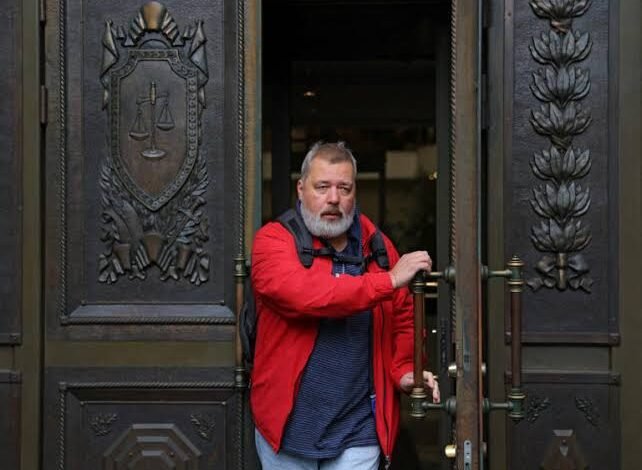
Six months after collecting the Nobel Peace Prize in Oslo, Dmitry Muratov was sitting on a train from Moscow to Samara when a stranger doused him in red paint mixed with acetone. The attack burned his eyes, led to four surgeries and left him needing a magnifying glass to read. NPR reported the assault on 7 April 2022, weeks after Russia had effectively made independent war coverage a criminal offence.
The short version: Dmitry Muratov is the Russian journalist who co-founded the newspaper Novaya Gazeta and shared the 2021 Nobel Peace Prize with the Philippines’ Maria Ressa, honoured, in the Norwegian Nobel Committee’s words, for efforts to safeguard freedom of expression. Russia has since stripped his newspaper of its licences, listed him as a foreign agent and made much of his life’s work illegal. As of April 2026 he still lives in Moscow and still publishes, in the narrow gaps the law leaves open.
From Kuibyshev to the front page
He was born on 29 October 1961 in Kuibyshev, the Volga city now called Samara. According to his Wikipedia biography, he studied philology, served in the Soviet Army as a signals specialist and saw time in Afghanistan. His first newsroom jobs were provincial. Then came Komsomolskaya Pravda, where he rose to head of the youth desk before leaving in 1992.
In 1993 he and around 50 colleagues from that paper founded Novaya Gazeta. The newsroom started with two computers, one printer and no salaries. Mikhail Gorbachev, the Soviet Union’s last leader and a Nobel Peace laureate himself, paid for some of the salaries and machines out of his own prize money, a detail Geneva Solutions confirmed in its coverage of the paper’s later shutdown.
One Russian Nobel laureate bankrolling the newspaper that would spend three decades annoying his successors. It is a neat loop of history, and it closed in 2022 when Muratov led Gorbachev’s funeral procession, a week before a Moscow court cancelled his paper’s print licence.
Muratov became editor-in-chief in 1995, stepped down in 2017 citing exhaustion, and returned in 2019 because the staff voted him back.
The colleagues who did not survive
Since 2000, six journalists and contributors connected to Novaya Gazeta have been killed. Igor Domnikov in 2000. Viktor Popkov in 2001. Yuri Shchekochikhin in 2003, poisoned after investigating a corruption scandal. Anna Politkovskaya in 2006, shot in the lift of her Moscow apartment block. Anastasia Baburova and Natalia Estemirova in 2009.
“I wanted to close the newspaper because it was the third death we’d suffered,” Muratov told El País in a November 2025 interview. “But my colleagues said no, that we had to keep working.” Three more died after that.
Intimidation did not always arrive as a bullet. In 2018, after an investigation into Yevgeny Prigozhin, someone delivered a severed ram’s head and funeral flowers to the newsroom. The Committee to Protect Journalists, which later gave Muratov one of its International Press Freedom Awards, once described Novaya Gazeta as the only truly critical newspaper with national influence in Russia.
Oslo, and a medal sold for $103.5 million
On 8 October 2021 the Norwegian Nobel Committee named Muratov and Ressa as laureates. Even the Kremlin sent congratulations. Muratov’s reaction was characteristically self-effacing: the prize, he said, really belonged to his dead colleagues, and he would rather it had gone to the imprisoned opposition leader Alexei Navalny.
Five months later he turned the medal into something more useful than a keepsake. On 22 March 2022, weeks after the full-scale invasion of Ukraine, he announced he would auction it. Heritage Auctions sold it in June 2022 for $103.5 million, the highest price ever paid for a Nobel medal, with the proceeds going to UNICEF for Ukrainian refugee children. Muratov praised UNICEF as an excellent choice to distribute the money, according to UN News.
The gesture later came with a sting. Pro-Kremlin activists reported him to the authorities, claiming he owes roughly $16 million in taxes on the proceeds. The New York Times reported in April 2026 that the tax investigation is still open.
How Russia closed Novaya Gazeta
The shutdown followed a schedule.
- 4 March 2022. Vladimir Putin signs a law imposing up to 15 years in prison for spreading what the state deems false information about the army.
- 28 March 2022. After a second warning from the regulator Roskomnadzor, Novaya Gazeta suspends publication inside Russia.
- 6 April 2022. Exiled staff launch Novaya Gazeta Europe from Riga.
- 7 April 2022. The paint attack on the Moscow to Samara train. US officials later concluded, according to The New York Times, that Russian intelligence organised it.
- 5 September 2022. A Moscow court strips the paper of its print licence. Muratov called the ruling, quoted by Geneva Solutions, “a political hit job, without the slightest legal basis”.
- 15 September 2022. The Supreme Court revokes the online licence too, as the Committee to Protect Journalists reported.
- June 2023. Novaya Gazeta Europe is declared undesirable, making it a criminal offence to share its articles inside Russia.
- 1 September 2023. Muratov himself is listed as a foreign agent, a designation the International Press Institute condemned at the time.
- Autumn 2023. By presidential decree, the printing houses that Norway’s Amedia had handed to Muratov are transferred to Moscow’s city authorities.
Where is Dmitry Muratov now?
He never left. That single fact separates him from almost every other prominent critic of the Kremlin. As of April 2026, according to a New York Times profile cited in his Wikipedia biography, Muratov continues to live in Russia, publishing YouTube videos and a limited-circulation magazine shaped to comply with the censorship laws and his foreign agent status. When the younger staff went into exile in 2022, the older hands held a readers’ vote on whether to continue. Thousands answered, he told El País. The readers said they understood everything and wanted the paper to keep going.
He still travels when he can. In June 2023 he came to Britain for Sheffield DocFest, attending the Crucible screening of The Price of Truth, a documentary about his newsroom. In August 2025 he told Swissinfo that he is not afraid to live without hope.
That November, at a summit in Vigo, Spain, he said Putin had made a mockery of European politicians who laid flowers for Politkovskaya and then signed gas contracts. In December 2025, as a Trump envoy travelled to Moscow, he told Reuters that the lives of political prisoners were at stake in any negotiation. By his count in the El País interview, around 48 journalists are behind bars in Russia.
As of this article’s review on 13 August 2026, there is no confirmed reporting that any of that has changed.
Why Muratov still matters
The Nobel Committee did not honour a man in isolation. It honoured a newspaper, and Russia responded by making that newspaper a crime. The sequence of warnings, licences, designations and decrees reads less like law enforcement and more like a demolition plan executed in paperwork.
What keeps Muratov interesting is not martyrdom but method. He works inside the lines of a rigged system, naming prisoners, counting the dead, correcting the record one YouTube video at a time. Free countries sit at the mild end of the same spectrum, arguing about how much political pressure a broadcaster should absorb, the same tension we examined in our piece on Fiona Bruce’s split-screen BBC career. His case is simply what happens when the pressure has no release valve.
Legacy, it turns out, is fragile everywhere. Institutions do not need a dictatorship to rewrite their own histories, as the BBC’s retroactive erasure of Huw Edwards showed in a very different context. In Russia the rewriting is done by the state, with a court stamp. Muratov’s answer is to keep a receipt of everything, which is what Novaya Gazeta always was. A receipt.
And the information business has a new enemy he worries about as much as the old one. Algorithms, he told El País, do whatever they want, and truth behaves like antibiotics: overuse stops it working. That is the same attention economy we dissected after Perez Hilton’s livestream meltdown, only with prison sentences attached.
In Vigo, asked whether he had any hope left, Muratov said no. Then the conversation turned to Russia’s under-30s, their empathy, their refusal of the war, and he smiled and conceded the point himself. Well, yes. The magnifying glass stays on his desk. So does he.
FAQs
Who is Dmitry Muratov and why did he win the Nobel Peace Prize?
Muratov co-founded Novaya Gazeta in 1993 and led it as editor-in-chief. He shared the 2021 Nobel Peace Prize with Maria Ressa for their efforts to safeguard freedom of expression in Russia and the Philippines.
Is Novaya Gazeta still operating in Russia?
Not as it was. Its print and online licences were revoked in September 2022. A reduced version continues inside Russia, while exiled staff run Novaya Gazeta Europe, which Russia has declared undesirable.
Why was Dmitry Muratov attacked on a train?
On 7 April 2022 an unknown assailant doused him with red paint and acetone on a Moscow to Samara train, apparently for his anti-war stance. US officials said Russian intelligence was behind the attack, according to The New York Times.
How much did Dmitry Muratov sell his Nobel Peace Prize medal for?
$103.5 million, at Heritage Auctions in June 2022, a record for a Nobel medal. The proceeds went to UNICEF for Ukrainian refugee children.
What does foreign agent mean in Russia?
A legal label applied to people and organisations the state says receive foreign support. It brings reporting obligations, compulsory disclaimers on everything published, fines and prosecution risk. Muratov was listed on 1 September 2023.
SOURCES
- WUSF / NPR, “Dmitry Muratov, a Nobel Peace Prize-winning journalist, was attacked in Russia” — Confirmed the date, location and nature of the paint attack on the Moscow to Samara train. Published: 7 April 2022. Accessed: 13 August 2026.
- NobelPrize.org, “Dmitry Muratov – Facts” — Confirmed the 2021 Peace Prize citation, birth date and editor-in-chief tenure. Published: October 2021, updated. Accessed: 13 August 2026.
- Wikipedia, “Dmitry Muratov” — Backbone timeline: early life, army service, founding of Novaya Gazeta, killed journalists, licence revocations, foreign agent listing, and the April 2026 status citing The New York Times. Published: continuously updated. Accessed: 13 August 2026.
- Geneva Solutions, “Moscow ban of Novaya Gazeta ‘another blow’ to independent Russian media, says UN” — Confirmed the 5 September 2022 print licence revocation, Muratov’s “political hit job” quote, Gorbachev’s funding and the funeral procession. Published: September 2022. Accessed: 13 August 2026.
- El País, “Dmitry Muratov, Russian journalist: ‘Putin has made a mockery of European politicians'” — Confirmed the Vigo lecture, the readers’ vote, the imprisoned-journalists figure and the hope exchange. Published: 28 November 2025. Accessed: 13 August 2026.
- Committee to Protect Journalists, “Dmitry Muratov, Editor of Novaya Gazeta, Russia” — Confirmed the CPJ award and its description of Novaya Gazeta as Russia’s only truly critical paper with national influence. Published: c. 2007, updated. Accessed: 13 August 2026.
- UN News, “Ukraine: Russian Nobel winner praises UNICEF as ‘excellent’ choice to distribute $103.5 million auction proceeds” — Confirmed the auction total and UNICEF’s role distributing the proceeds. Published: June 2022. Accessed: 13 August 2026.
- Heritage Auctions, “The Dmitry Muratov Nobel Peace Prize Medal” — Confirmed the $103,500,000 hammer price and the UNICEF beneficiary. Published: June 2022. Accessed: 13 August 2026.
- Committee to Protect Journalists, “Russian authorities revoke Novaya Gazeta’s online media license” — Confirmed the Supreme Court’s 15 September 2022 revocation of the online licence. Published: September 2022. Accessed: 13 August 2026.
- Committee to Protect Journalists, “Russia bans independent outlet Novaya Gazeta Europe, adds to undesirable list” — Confirmed the June 2023 undesirable designation of the exiled edition. Published: June 2023. Accessed: 13 August 2026.
- International Press Institute, “Russia designates Dmitry Muratov as a ‘foreign agent'” — Confirmed the 1 September 2023 foreign agent designation. Published: 1 September 2023. Accessed: 13 August 2026.
- Sheffield DocFest, “Nobel Prize Winning ‘Novaya Gazeta’ Editor Dmitry Muratov attend Sheffield DocFest” — Confirmed his in-person UK appearance at the 17 June 2023 screening of The Price of Truth. Published: June 2023. Accessed: 13 August 2026.
- Swissinfo, “Dmitry Muratov: ‘I’m not afraid to live without hope'” — Confirmed the August 2025 interview and its central quote. Published: 14 August 2025. Accessed: 13 August 2026.
- Reuters, via TradingView, “As Trump envoy heads to Moscow, Russian Nobel winner says prisoners’ lives are at stake” — Confirmed the December 2025 statement tying prisoner lives to the Trump envoy’s Moscow trip. Published: 1 December 2025. Accessed: 13 August 2026.