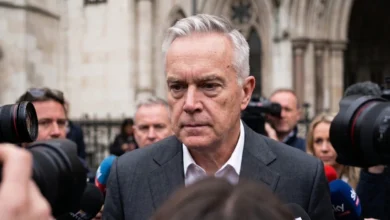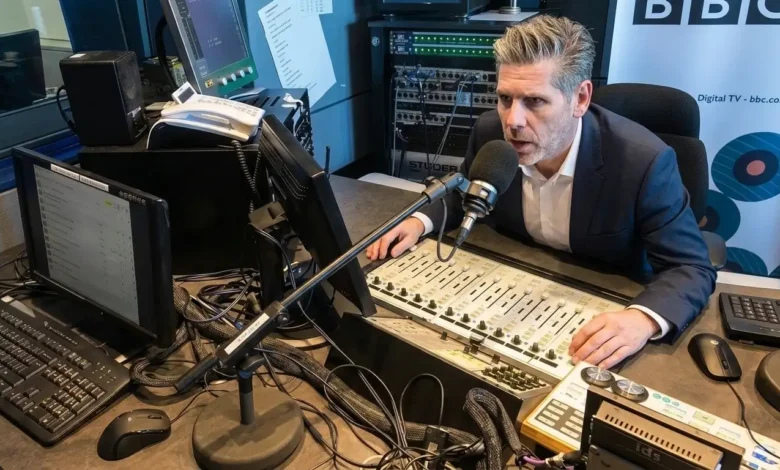
When a public broadcaster investigates its own talent, the journalism is rarely just reporting; it is institutional estate management.
On 3 August 2026, the BBC confirmed that presenter Tony Livesey had parted ways with the corporation after sixteen years at Radio 5 Live. The announcement was brief, but its implications ripple far beyond a schedule change in late-night broadcasting. What began in June 2026 as a temporary decision to step back from his weeknight slot ended in a permanent exit, demonstrating how rapidly historical professional ties can dissolve a modern broadcasting identity.
The Tony Livesey BBC departure arrived after a joint investigation by BBC Panorama and The Times examined allegations of sexual misconduct against David Sullivan, the billionaire businessman and co-owner of West Ham United.
Before Livesey became a familiar, comforting voice to late-night listeners across Britain, he spent eighteen years inside Sullivan’s tabloid empire, serving as editor-in-chief and managing director of the Daily Sport and Sunday Sport until 2006.Featured Snippet Answer:The Tony Livesey BBC departure occurred on 3 August 2026, ending his 16-year career at BBC Radio 5 Live. Livesey stepped down following a BBC Panorama and The Times investigation into his former employer, Sport Newspapers owner David Sullivan, which raised questions regarding a 1999 introduction. Livesey maintains he has no recollection of the event.
The Tabloid Inheritance and the Broadcasting Sanctuary
To understand how a veteran broadcaster found his contract truncated in August 2026, one must re-examine the unusual trajectory of late-twentieth-century British journalism. Livesey began his career in regional print at the Lancashire Telegraph before stepping into the raucous world of red-top publishing. For nearly two decades, his name was synonymous with the Daily Sport, a publication that traded on sensationalism, cheekiness, an
When he transitioned to the BBC in the late 2000s, the move was hailed as a successful reinvention. Livesey brought a down-to-earth, Northern authenticity to BBC Radio Lancashire and later to Radio 5 Live, where he co-hosted daytime slots alongside Sarah Brett before taking stewardship of the 10pm late-night talk show. His style was accessible, unpretentious, and distinctly human. Listeners trusted him because he sounded like the pub conversationalist who had somehow wandered into a studio and mastered the faders.
Yet institutional sanctuaries are built on conditional trust. The BBC of the mid-2020s operates under an exacting regime of reputational governance. Broadcasters are no longer permitted to keep their past careers locked in separate filing cabinets. When historic industry practices are scrutinised under modern ethics, the boundary between an individual’s past employment and their present employer vanishes instantly.
The Panorama Investigation: When History Re-enters the Frame
“I have no recollection of the event,” was the central line in Livesey’s response when the joint BBC Panorama and The Times report aired in early June 2026.
The documentary detailed allegations from multiple women regarding David Sullivan’s behaviour during his tenure as a newspaper publisher. Among the testimony was a specific claim from one woman stating that Livesey had introduced her to Sullivan in 1999 during his time as editor-in-chief. Sullivan has categorically denied all allegations of wrongdoing.
Livesey immediately asked to step back from his presenting duties while the BBC reviewed the issues raised by its own investigative flagship. For eight weeks, his late-night frequency fell quiet, replaced by cover presenters while corporate executives assessed the findings. The optics were inherently complex: a public service broadcaster broadcasting a forensic audit of a former tabloid executive who was currently one of its own premier radio hosts.
Why did a 1999 introduction trigger a 2026 departure?
In modern broadcasting, the issue is rarely legal liability alone; it is institutional alignment. When the BBC’s flagship current affairs strand reports on historic workplace dynamics within a tabloid newsroom, the corporation cannot maintain a double standard for its own microphone holders. Even without legal findings against Livesey, the reputational friction between Radio 5 Live’s news-led ethos and the allegations surrounding the Sport Newspapers era proved untenable.
The Institutional Imperative of BBC Discretion
The resolution on 3 August 2026 was swift and final. A short BBC statement confirmed that Livesey had left the broadcaster, bringing a sixteen-year partnership to a silent close. There were no emotional on-air handovers, no retrospective compilation tapes, and no celebratory final shows.
This silent exit reflects a broader corporate trend across British media. In an era dominated by rapid digital commentary and intense public scrutiny, institutions prefer clean severance to prolonged debates over historical conduct. The BBC’s decision highlights how strictly the corporation guards its editorial integrity, particularly when handling matters connected to its own investigative journalism.
Livesey’s career at 5 Live spanned major political upheavals, national sporting triumphs, and thousands of hours of late-night talk radio. He was a master of the open-line format, adept at balancing light-hearted banter with sensitive personal caller stories. Yet his departure proves that long-term broadcasting success cannot fully insulate a presenter from the retrospective examination of their earlier career choices.
Fleet Street Echoes in the Era of Accountability
The tabloid environment of the 1990s operated under cultural rules that seem entirely foreign to contemporary newsrooms. What was once dismissed as Fleet Street irreverence is now evaluated through the lens of modern corporate accountability and personal liability.
For 16 years, Livesey successfully navigated the distance between the Daily Sport and BBC Broadcasting House. He demonstrated that a print editor could transform into a respected public service broadcaster. But as news organizations increasingly investigate the broader media ecosystems of past decades, legacy ties can re-emerge with decisive force.
The Tony Livesey BBC departure serves as a definitive case study in modern media governance. It illustrates that in contemporary journalism, a presenter’s history is never truly archived. When the spotlight of public accountability turns backward, even a well-established broadcasting identity can be reshaped in a single news cycle.
Confirmed vs. Assumed
Public reporting confirms that Tony Livesey stepped down from BBC Radio 5 Live in June 2026 and permanently departed the BBC on 3 August 2026 following a joint Panorama and The Times investigation into David Sullivan. It is verified that Livesey served as editor-in-chief of the Daily Sport until 2006 and that he stated he has no recollection of arranging a 1999 meeting cited in the broadcast.
Sullivan’s complete denial of all allegations is equally established in the official record. What remains an editorial interpretation rather than an established fact is the precise internal deliberation within BBC management that led from June’s temporary step-back to August’s permanent exit, as the corporation has not published internal human resources files or contractual severance terms.
Frequently Asked Questions
Why did Tony Livesey leave BBC Radio 5 Live?
A1: Tony Livesey left BBC Radio 5 Live on 3 August 2026 following an investigation by BBC Panorama and The Times into his former employer, David Sullivan. The report raised questions about historical ties and a 1999 meeting during Livesey’s tenure at the Daily Sport.
Did Tony Livesey face any criminal charges?
A2: No criminal charges or legal proceedings were brought against Tony Livesey. His exit from the BBC was an administrative departure connected to corporate reputational management and historical association rather than a legal finding.
What was Tony Livesey’s response to the Panorama allegations?
A3: Livesey stated publicly that he had no recollection of the 1999 introduction described in the Panorama documentary. He voluntarily stepped back from his radio show in June 2026 while the BBC reviewed the situation.
How long was Tony Livesey at the BBC?
A4: Tony Livesey worked at the BBC for sixteen years, joining Radio 5 Live in 2010 after presenting regional programmes for BBC Radio Lancashire and BBC North West.
Sources
- The Guardian — “Radio presenter Tony Livesey leaves BBC after David Sullivan allegations” — 3 August 2026
- RadioToday — “Tony Livesey steps down from BBC Radio 5 Live” — 3 August 2026
- Radio Times — “Presenter Tony Livesey departs BBC Radio 5 Live after 16 years” — 3 August 2026
- Broadcast Now — “Tony Livesey to leave the BBC” — 3 August 2026
- Press Gazette — “Tony Livesey off-air as BBC airs David Sullivan allegations” — 9 June 2026
- The Mirror — “Tony Livesey leaves BBC after 16 years following Panorama investigation” — 3 August 2026