Cambridge has produced professors of Ancient Greek, of astrophysics, of Sanskrit. Until January 2025 it had never produced a professor of being good at explaining things. Then it invented the job and gave it to a woman who once got a PhD in fluid dynamics specifically so she could go and work in Formula One, hated it, and left.
That single fact tells you most of what you need to know about how Hannah Fry’s career actually works. The institutions keep arriving after the audience already has.
The Chair That Was Built Around Her
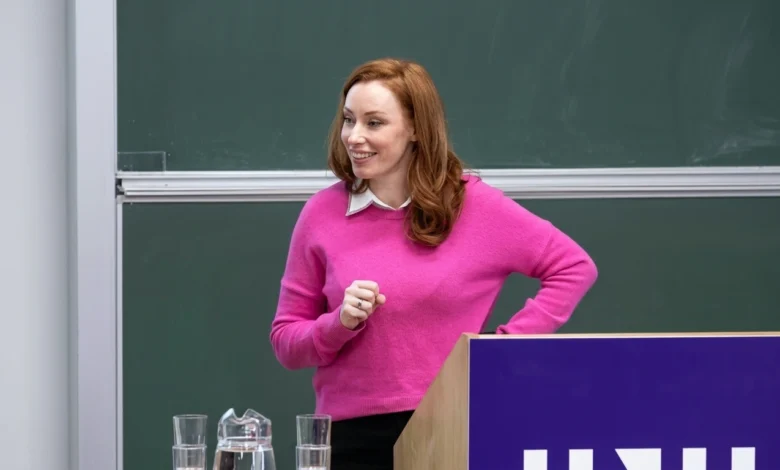
Fry joined the University of Cambridge in January 2025 as its first Professor of the Public Understanding of Mathematics, a title that did not exist as a job description before she took it, according to Cambridge’s Faculty of Mathematics. She is a fellow of Queens’ College and president of the Institute of Mathematics and its Applications. As of late July 2026, that chair has already produced its first major dividend: the Leelavati Prize, awarded once every four years by the International Mathematical Union and Infosys at the International Congress of Mathematicians for outstanding contributions to public engagement with mathematics, per Cambridge’s own announcement and Plus Magazine’s coverage of this year’s ICM.

The prize is awarded once every four years. Fry got hers eighteen months into a job that did not exist before she took it.
Hannah Fry is a British mathematician, author and broadcaster who became Cambridge’s first Professor of the Public Understanding of Mathematics in 2025 and won the 2026 Leelavati Prize, mathematics’ top honour for public engagement, off the back of a career spanning TED talks, BBC documentaries and bestselling books.
A Fluid Dynamicist Who Fled Formula One
The origin story is stranger than the current job title suggests. Fry studied mathematics at UCL, stayed on for a PhD in fluid dynamics — her thesis, submitted in 2011, was titled A Study of Droplet Deformation — and took a brief detour into Formula One as an aerodynamicist before deciding the industry was not for her, as The Week reported drawing on an earlier profile in The i Paper. She went back to academia. Then, in 2015, a TED talk on the mathematics of love went viral, and the broadcasting career started almost by accident.
Why did a droplet-deformation thesis end up on Have I Got News for You?
Because television, it turns out, wanted exactly what the thesis had: someone who could take a genuinely technical mind and make it legible on camera. Fry built a substantial catalogue off that TED talk. BBC documentaries on climate statistics, on Ada Lovelace, on the mathematics of pandemics two years before one arrived. A long-running BBC Radio 4 series, The Curious Cases of Rutherford and Fry, now in its third decade of episodes. The 2019 Royal Institution Christmas Lectures. A 2018 book, Hello World, which took a genuinely sceptical look at algorithmic decision-making and went on to win the 2020 Asimov Prize.
The Year She Turned the Statistics on Herself
In 2021, at thirty-six, Fry was diagnosed with cervical cancer after a routine smear test. She opted for a radical hysterectomy, and the surgery left her managing lymphoedema, a chronic swelling condition, which she has spoken about treating with further surgery and regular Pilates.
“It was very close to being very bad but I got really lucky. I got away with it,” Fry told UCL in a 2021 interview.
The period also coincided, by her own account as reported by The Week, with the end of her marriage — a subject she has discussed only briefly and largely on her own terms. What she chose to do with the diagnosis itself was more public: a BBC Horizon documentary, Making Sense of Cancer with Hannah Fry, in which she filmed her own treatment while interrogating the statistics behind cancer screening and overdiagnosis.
She turned the diagnosis into a documentary rather than into silence.
Two Million Followers, One Very Serious Prize
This is where the Bolder Thesis of the whole career sits. Fry’s Instagram account, @fryrsquared, has built an audience of more than two million people on a mix of fluid-dynamics explainers and myth-busting about everything from Victorian corsetry to cubic zirconia. With the American science YouTuber Michael Stevens, she co-hosts The Rest Is Science, which won Best New Entertainment and Culture Podcast at the 2026 Webby Awards. TIME placed her on its 2026 Creators list alongside people whose fame runs almost entirely through algorithms and platform metrics.
Fry’s fame runs through platforms too. What is unusual is the direction the institutions have moved in response. The Royal Society gave her its David Attenborough Award in 2024. The Institute of Mathematics and its Applications, of which she is now president, gave her its Christopher Zeeman Medal back in 2018. Cambridge invented an entire professorship. Most creators spend a career chasing legitimacy from institutions that never quite arrives. In Fry’s case the institutions kept showing up uninvited.
A Scottish Castle Is the Strangest Line on Her CV
The newest addition to that list is not academic at all. Fry is one of twenty-one contestants on the BBC’s Celebrity Traitors, filmed at a castle in the Scottish Highlands, joining a cast that includes Ross Kemp, Joe Lycett, James Blunt and Jerry Hall, competing for a charity prize of up to £100,000, according to the Cambridge Independent’s report on the casting.

Alongside that sits The Future with Hannah Fry, a BBC Two series adapted from an Emmy-winning Bloomberg Originals format, in which she has spent 2026 travelling between California’s longevity biohackers and Japan’s centenarian researchers, and later touring the ITER fusion reactor in southern France, examining a project whose own timeline has slipped by nearly a decade since it was first filmed.
A professor whose job title did not exist eighteen months ago is currently deciding who to banish from a castle on prime-time television, and Cambridge does not appear to have a problem with any of it.
Frequently Asked Questions
Is Hannah Fry still a professor at UCL?
No. She left her professorship in the mathematics of cities at UCL’s Centre for Advanced Spatial Analysis to join Cambridge in January 2025 as its first Professor of the Public Understanding of Mathematics.
What is the Leelavati Prize?
It is awarded every four years by the International Mathematical Union and Infosys at the International Congress of Mathematicians, recognising outstanding contributions to public engagement with mathematics. Fry received it in 2026.
What podcast does Hannah Fry host now?
The Rest Is Science, co-hosted with Michael Stevens, which won Best New Entertainment and Culture Podcast at the 2026 Webby Awards.
Has Hannah Fry recovered from cervical cancer?
She has described herself as cancer-free following her 2021 diagnosis and radical hysterectomy, and continues to manage lymphoedema resulting from the surgery.
Why is Hannah Fry appearing on Celebrity Traitors?
She is one of twenty-one contestants on the BBC series, filmed in the Scottish Highlands, competing for a charity prize of up to £100,000.
Sources
- Cambridge Faculty of Mathematics: “Professor Hannah Fry wins Leelavati Prize” — reported July 2026
- Plus Magazine: “The Leelavati Prize 2026: Hannah Fry” — reported July 2026
- TIME: “Hannah Fry Is on the 2026 TIME100 Creators List” — Shannon Carlin, reported July 14, 2026
- Cambridge Independent: “University of Cambridge’s Professor Hannah Fry among The Celebrity Traitors 2026 contestants” — Paul Brackley, reported May 10, 2026
- UCL News: “Interview: Dr Hannah Fry” — reported July 2021
- Wikipedia: “Hannah Fry” — general biographical corroboration (date unconfirmed)